Why Staying Calm Is Your Greatest Advantage
Have you ever had this happening to you: You are opening your investment app on a Monday morning and see that your portfolio has lost 12% in just a few weeks.
The headlines aren’t helping either. Every news outlet seems to predict another crash. Social media is filled with people claiming that “this time is different,” and suddenly you begin to wonder whether you should sell before things get even worse.
If you’ve ever felt this way, you’re not alone.
Almost every investor experiences moments of doubt when markets become volatile. Watching your investments lose value is uncomfortable, especially when you’ve worked hard to save that money. But here’s the important part: market volatility is not a sign that investing has stopped working. It is simply part of the journey.
Learning to stay calm during these periods is one of the most valuable financial skills you can develop. In fact, your success as an investor often depends less on choosing the perfect investment and more on avoiding emotional decisions when markets become unpredictable.
Volatility Isn’t the Exception – It’s the Rule
Many new investors expect the stock market to grow steadily over time. Unfortunately, that’s not how it works.
Markets move because millions of investors react to economic data, company earnings, political events, technological breakthroughs, interest rates, and sometimes simply fear or optimism. Every day, buyers and sellers try to predict the future, and their opinions constantly change. The result is a market that rarely moves in a straight line.
Some years deliver exceptional returns. Others bring disappointing losses. Between those periods are countless smaller corrections that can feel dramatic in the moment but barely register when looking back years later.
If you zoom out far enough, however, a different picture appears.
Over the past several decades, global stock markets have experienced financial crises, wars, recessions, inflation, pandemics, banking failures, and political uncertainty. Despite all of these events, the long-term direction has remained remarkably consistent: upward.
This doesn’t mean markets are guaranteed to rise every year. It means that temporary declines have historically been the price investors pay for long-term growth.
Volatility isn’t a flaw in the system.
It’s the admission fee.
Why Our Brains Make Investing So Difficult
One reason market downturns feel so stressful is that our brains are wired to avoid losses.
Losing $1,000 usually feels much worse than gaining $1,000 feels good. Psychologists call this loss aversion, and it’s one of the biggest reasons investors make poor decisions.
When prices fall, our instincts tell us to protect ourselves immediately. Selling feels like taking control. Waiting feels passive and risky. Unfortunately, investing often rewards behavior that feels uncomfortable.
History has shown that some of the market’s strongest recovery days happen shortly after its worst declines. Investors who panic and sell during those difficult moments often miss the rebound that follows.
The problem isn’t that markets become volatile, the problem is that emotions tempt us to abandon a good plan at exactly the wrong time.
A Personal Story
I personally had the good fortune of adjusting my portfolio structure in February 2022, just days before the war between Russia and Ukraine began. My plan was to shift from a two-ETF portfolio to a four-ETF portfolio in order to gain more flexibility and reduce overexposure to the US market.
To execute this, I set a realistic trade limit, scheduled the adjustment over two weeks, and then avoided checking my portfolio for several days. After the market drop, I realized that I had effectively sold a large portion of my holdings close to a very favorable point and was later able to buy back into new ETFs at roughly 15% lower prices.
However, this event – fortunate as it was – taught me something more important. I have absolutely no idea how the stock market will behave the next day, the next week, or even the next month. Successful investing does not rely on foresight or trying to predict the future. Instead, it depends on having a strategy that remains robust without needing constant adjustments based on short-term market conditions.
If I had sold out of fear of an even larger crash, in an attempt to time the market, I would likely have made the switch at a financial loss instead.
Time Beats Timing
One of the biggest myths in investing is that successful investors know exactly when to buy and sell.
In reality, almost nobody can consistently predict market movements. Professional fund managers with teams of economists regularly fail to outperform simple index funds over long periods. If experts struggle to time the market, individual investors shouldn’t expect to do it successfully either.
Instead of trying to find the perfect moment, successful investors focus on something they can actually control:
Staying invested. Every year spent waiting for “the right time” is another year your money isn’t compounding. Every attempt to predict the next crash introduces another opportunity to be wrong. The famous saying is true because it captures decades of investing experience:
Time in the market beats timing the market.
Falling Markets Can Actually Work in Your Favor
When markets fall, most people only see losses but long-term investors often see opportunity.
Imagine you invest $500 every month into a global ETF regardless of what the market is doing.
When prices are high, your $500 buys fewer ETF shares, when prices fall, the exact same $500 buys more shares. You aren’t trying to predict when markets will recover but you’re simply accumulating more ownership while prices are lower.
Years later, when markets recover – as they have repeatedly throughout history – you own more shares than you would have if prices had never fallen. Ironically, investors who continue buying during downturns often benefit the most from the eventual recovery. This is one of the reasons automatic investing is such a powerful strategy.
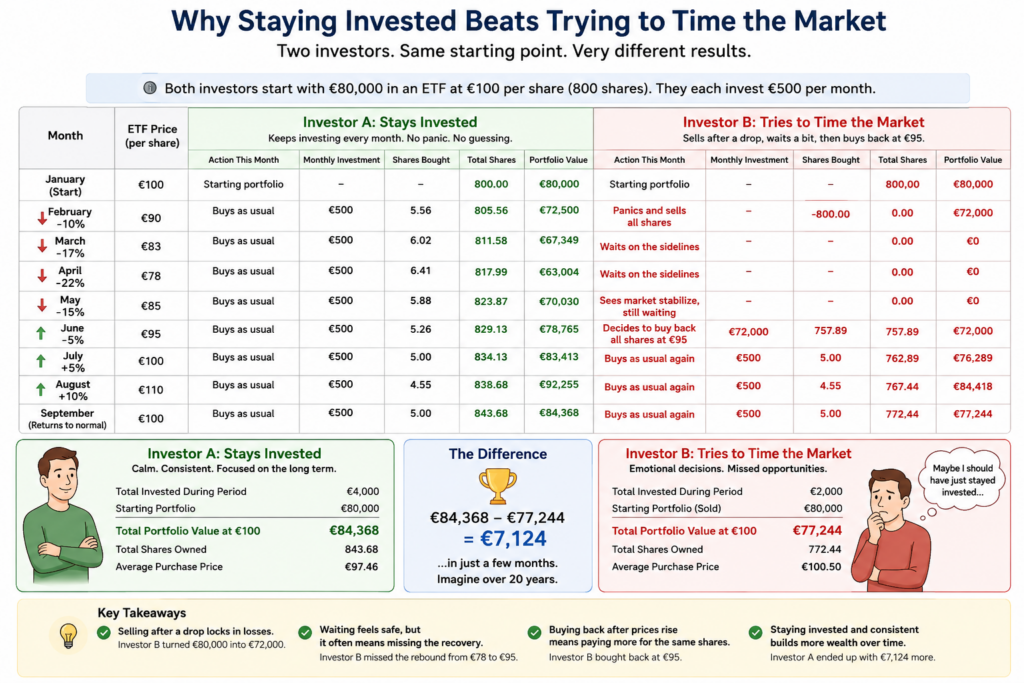
What Happens When You Invest Monthly Instead of Trying to Time the Market
The table below compares two investors with the same starting capital. One invests consistently every month, while the other tries to react to market movements. Over time, the difference in strategy leads to a clear gap in results.
| Month | ETF Price | Investor A – Keeps Investing | Shares Bought | Total Shares | Investor B – Tries to Time the Market | Shares Bought | Total Shares |
|---|---|---|---|---|---|---|---|
| Start | €100 | Starts with €80,000 | – | 800.00 | Starts with €80,000 | – | 800.00 |
| January | €100 | Invests €500 | 5.00 | 805.00 | Invests €500 | 5.00 | 805.00 |
| February | €90 | Invests €500 | 5.56 | 810.56 | Sells everything (€72,450) | -805.00 | 0.00 |
| March | €80 | Invests €500 | 6.25 | 816.81 | Waits | 0.00 | 0.00 |
| April | €85 | Invests €500 | 5.88 | 822.69 | Waits | 0.00 | 0.00 |
| May | €95 | Invests €500 | 5.26 | 827.95 | Buys back for €72,450 + invests €500 | 768.95 | 768.95 |
| June | €110 | Invests €500 | 4.55 | 832.50 | Invests €500 | 4.55 | 773.50 |
| July | €120 | Invests €500 | 4.17 | 836.67 | Invests €500 | 4.17 | 777.67 |
| August | €110 | Invests €500 | 4.55 | 841.22 | Invests €500 | 4.55 | 782.22 |
| September | €100 | Invests €500 | 5.00 | 846.22 | Invests €500 | 5.00 | 787.22 |
End Result
| Investor A | Investor B | |
|---|---|---|
| Starting Portfolio | €80,000 | €80,000 |
| Additional Contributions | €4,500 | €3,000 |
| Final Shares | 846.22 | 787.22 |
| Final Portfolio Value | €84,622 | €78,722 |
| Difference | €5,900 |
The Power of Investing Every Month
Without doing anything special, you’ve ended up purchasing more shares during periods when prices were lower. Over time, this naturally increases the number of shares you own.
If you had invested the same amount of money each month at a fixed price of $100, regardless of market movements, you would actually own fewer shares after six months compared to a scenario where prices fluctuate.
Market declines rarely feel pleasant in the moment. They are associated with uncertainty and discomfort, and it can be difficult to stay consistent when values are falling.
But for investors who are still building wealth, those periods often work in their favor. They allow you to accumulate more assets at lower prices, effectively improving your long-term position without doing anything differently.
And that is exactly what matters when your investment horizon is measured in decades rather than months.
Diversification Makes the Ride Smoother
No investment is risk-free. Even the world’s largest companies can face difficult years, and entire industries sometimes struggle for extended periods. That’s why putting all your money into a single company or sector can be a risky strategy.
Diversification helps reduce that risk.
Instead of relying on one business to succeed, you spread your investments across hundreds or even thousands of companies operating in different countries and industries. Some may perform poorly, while others continue to grow. Together, they create a portfolio that is generally more stable than any single investment.
This is one of the biggest advantages of broad-market ETFs. With a single investment, you can own a small piece of companies from around the world. You don’t need to predict which business will become the next big winner because you’re already invested in all of them.
Diversification doesn’t eliminate volatility. Your portfolio will still rise and fall as markets move. What it does reduce is the risk that one bad investment permanently damages your long-term results.
Think of it like building a football team. You wouldn’t want eleven goalkeepers, no matter how talented they are. A balanced team performs better over the course of a season, just as a diversified portfolio performs better over the course of decades.
Turn Down the Noise
One of the biggest challenges during volatile markets isn’t the market itself.
It’s the constant stream of news.
Every market decline is accompanied by dramatic headlines. Financial media compete for attention, and “Markets Down 2%” rarely attracts as many clicks as “The Next Financial Crisis Has Begun.”
Negative news naturally receives more attention because humans are wired to notice potential danger. As a result, it can feel like the world is falling apart, even when markets are simply going through a normal correction.
Remember that the news reports what is happening today. Your investment plan is built for the next ten, twenty or thirty years. Those are very different time horizons.
If you find yourself checking financial news several times a day or opening your investment app every few hours, consider taking a step back. Looking at short-term movements too often makes temporary fluctuations feel much more important than they really are.
Successful investors don’t ignore the news.
They simply refuse to let every headline change their strategy.
Practical Rules for Volatile Markets
When emotions run high, simple rules can prevent expensive mistakes.
First, keep your monthly investments running. Automatic investing removes emotion from the decision and allows you to buy consistently through good times and bad.
Second, avoid making decisions based on a single day’s market movement. A 3% drop might feel dramatic, but over decades it is little more than background noise.
Third, make sure you have an emergency fund before investing. Knowing that you have cash available for unexpected expenses makes it much easier to leave your investments untouched during market downturns.
Finally, remember why you started investing in the first place. Whether your goal is retirement, financial independence, your children’s future or simply building long-term wealth, those goals haven’t changed just because the market had a bad week.
The Biggest Mistake Investors Make
The greatest risk during a market downturn is often not the decline itself but the decisions investors make because of it. Falling prices create uncertainty, and uncertainty can easily turn into fear. As a result, many people sell after their portfolio has already lost value, hoping to avoid even larger losses.
The problem is that markets usually recover long before confidence returns. By the time the news becomes optimistic again and investing finally feels “safe,” prices have often climbed significantly. Investors who sold during the downturn end up buying back at higher prices, locking in their losses and owning fewer shares than before.
Long-term investors take a different approach. They accept that market corrections, bear markets, and recessions are a normal part of investing rather than something to be avoided at all costs. Instead of changing their strategy whenever markets become volatile, they build a plan that can withstand difficult periods and trust it to work over the long run. The objective isn’t to eliminate volatility – it’s to avoid letting emotions dictate investment decisions.
Trust the Process
Successful investing is rarely exciting, and that’s exactly what makes it effective. Most wealth is built through a series of ordinary decisions repeated consistently over many years. You save part of your income, invest regularly, stay diversified, and allow compounding to do its work without constantly interfering.
There will always be another crisis, another recession, another alarming headline, and another prediction that “this time is different.” While every downturn feels unique in the moment, history shows that markets have repeatedly recovered and continued growing over the long term. Rather than trying to predict every rise and fall, successful investors rely on a strategy that doesn’t require perfect timing. They understand that consistency, patience, and discipline are far more valuable than trying to outguess the market.
Disclaimer
The information in this article is for educational purposes only and does not constitute financial advice. Always do your own research or consult a qualified financial advisor before making investment decisions. Past performance does not guarantee future results, and all investments carry risk, including the potential loss of capital.