A Simple Guide to Getting Started
At some point, almost everyone asks the same question: Should I start investing?
The answer is usually: Yes, but not immediately.
Investing is one of the most effective ways to build wealth over the long term, yet it only works well when it rests on a solid financial foundation. If you’re living paycheck to paycheck, carrying expensive debt, or don’t have any emergency savings, investing shouldn’t be your first priority.
That’s why, in our Financial Ladder, investing comes after you’ve learned to budget, built an emergency fund, and taken control of your finances. Once those pieces are in place, investing becomes the next logical step.
What Does Investing Actually Mean?
Investing means using your money to buy assets that have the potential to increase in value over time or generate income. Instead of letting your savings sit in a bank account, you put them to work.
The goal isn’t to get rich quickly. It’s to allow your money to grow steadily over many years.
That growth can come from rising prices, dividend payments, interest, rental income, or a combination of these. While markets move up and down in the short term, history has shown that diversified investments have rewarded patient investors over long periods.
Why Starting Early Matters
The biggest advantage an investor has isn’t choosing the perfect stock or predicting the market.
It’s time. And to be exactly it is the time you are invested in something, that you really believe in.
Every year your investments remain invested gives them another opportunity to grow. As those gains begin generating gains of their own, your portfolio starts benefiting from compound growth.
Many of my friends did believe they should wait until they earn more money. In reality, investing modest amounts consistently often produces better long-term results than waiting years to make larger investments. Try my investment calculator below to see the results for yourself.
Before You Buy Your First Investment
Before opening a brokerage account, ask yourself a few simple questions.
- Do you have an emergency fund?
- Have you paid off high-interest debt?
- Can you invest money without needing it again next month?
If the answer to these questions is yes, you’re probably ready to begin investing. If not, strengthening your financial foundation will usually have a greater impact than buying investments too early.
Diversification Is Your Best Protection
One investment can perform exceptionally well – or exceptionally poorly.
That’s why experienced investors spread their money across many companies, industries and countries rather than relying on a handful of investments.
Diversification won’t prevent temporary losses during difficult market periods. What it does is reduce the risk that one bad investment has a lasting impact on your financial future.
For most beginners, this is exactly why broad-market ETFs have become such a popular choice. They provide instant diversification without requiring investors to research dozens or hundreds of individual companies.
Understanding Risk
Every investment involves risk. That is something, you will have to accept when you are investing.
Generally speaking, investments with higher expected returns also experience larger price fluctuations. Stocks tend to grow more over long periods but can fall sharply during market downturns. Bonds usually fluctuate less but also offer lower expected returns.
The right balance depends on your personal situation. Someone investing for retirement in thirty years can usually tolerate more short-term volatility than someone planning to use the money within the next three years.
Choosing the right level of risk isn’t about maximizing returns. It’s about building a portfolio you can stick with when markets inevitably become unpredictable.
A Simple Strategy for Beginners
Many new investors spend months comparing funds, reading market forecasts and searching for the perfect investment.
Most don’t need a complicated strategy.
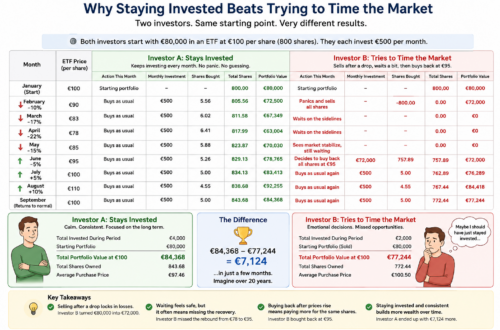
A diversified, low-cost ETF combined with regular monthly contributions is enough for many long-term investors. By investing consistently, you automatically buy more shares when prices are low and fewer when prices are high, reducing the pressure to time the market.
Successful investing is usually less about making brilliant decisions and more about repeating good ones.
Investment Growth Calculator
Use the calculator below to see how regular contributions and compound growth can influence your portfolio over time. Small monthly investments may not seem impressive today, but over decades they can develop into substantial amounts.
Investment Growth Calculator
See how your money grows over time with compound interest.
Common Investment Types
Stocks
Buying a stock means buying a small ownership stake in a company. Stocks have historically delivered some of the strongest long-term returns, but they also experience significant price swings. Investors who stay invested through market cycles have generally been rewarded over time.
Bonds
Bonds are loans made to governments or companies. They typically produce lower returns than stocks but help reduce overall portfolio volatility and provide greater stability.
Exchange-Traded Funds (ETFs)
ETFs combine many investments into a single fund. Instead of selecting individual companies yourself, one ETF can provide exposure to hundreds or even thousands of businesses around the world. For many beginners, this is one of the simplest ways to build a diversified portfolio.
Mutual Funds
Mutual funds also invest in diversified portfolios but are professionally managed. While some outperform the market, higher management fees can reduce long-term returns, making cost an important factor when comparing funds.
Real Estate
Property can generate rental income while increasing in value over time. It also requires considerably more capital, ongoing maintenance and is much less liquid than stocks or ETFs.
Gold
Gold has traditionally been used as a store of value during periods of uncertainty. It may provide diversification, but unlike businesses or bonds, it doesn’t generate income.
Cryptocurrencies
Cryptocurrencies have created enormous opportunities as well as enormous losses. Their prices can change dramatically within short periods, making them one of the most volatile investment categories. Beginners should understand these risks before allocating any meaningful portion of their portfolio.
Final Thoughts
Investing isn’t about finding the next big winner.
It’s about building a system that you can follow for decades.
A clear financial plan, regular contributions, broad diversification and patience have helped far more investors build wealth than chasing market trends ever has.
If you’ve already built your financial foundation, investing is no longer something to postpone. It’s simply the next step in allowing your money to work for you.
Disclaimer: This article is for informational purposes only and should not be taken as financial advice. Every investment involves risks, and it’s important to do your own research or consult with a licensed financial advisor before making decisions.