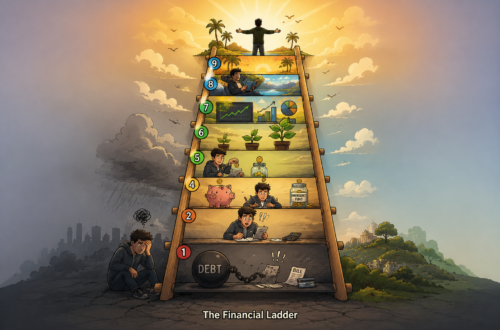
When Money Gives You Freedom
For many people, financial independence feels like the finish line. After years of saving, investing and watching your portfolio grow, it seems like the moment everything changes. In reality, reaching financial independence isn’t the end of your journey—it’s the beginning of a very different one.
Until now, your goal has been straightforward: earn more than you spend, invest the difference and give your portfolio time to grow. Once your investments are capable of supporting your lifestyle, however, your priorities begin to shift. Building wealth becomes less important than preserving it, and your portfolio changes from a growth engine into the foundation of your financial freedom.
Financial independence doesn’t necessarily mean retiring early. For many people, it simply means having choices. You might continue working because you enjoy your career, reduce your hours to spend more time with your family, start your own business or finally pursue projects that were never possible while relying on every monthly paycheck.
That freedom—not unlimited wealth—is what financial independence is really about.
How Much Is Enough?
One of the biggest surprises on the path to financial independence is that your income matters less than your spending.
Many people assume they need to become millionaires before they can stop worrying about money. In reality, the amount you need depends largely on the lifestyle you want to support. A family spending $40,000 per year needs a much smaller portfolio than one spending $80,000, even if both earn the same salary today.
This is why financial independence is such a personal goal. There is no universal number that works for everyone.
A commonly used guideline is the 4% Rule, which suggests that a diversified investment portfolio may support annual withdrawals of roughly four percent over a long retirement. Looking at it from the opposite direction, many investors estimate their target portfolio by multiplying their yearly spending by twenty-five.
It’s important to remember that this is only a planning tool, not a guarantee. Future market returns, inflation, taxes and personal circumstances will always influence the outcome. Still, the calculation provides something incredibly valuable: a clear destination instead of a vague dream.
Living From Your Portfolio
Saving and investing are relatively simple concepts. You earn money, invest part of it and repeat the process every month.
Financial independence introduces a completely new challenge.
Instead of asking how to grow your portfolio, you now ask how your portfolio can support your life without running out of money. That requires a different way of thinking because money is no longer flowing into your investments—it is gradually flowing out.
Some investors prefer withdrawing a fixed amount every year because it makes budgeting simple and predictable. Others withdraw a percentage of their portfolio so spending automatically adjusts to market performance. Many financially independent people combine both approaches, covering essential expenses while remaining flexible with discretionary spending during difficult market years.
There is no single perfect strategy. The best approach is usually the one that allows you to sleep well at night while keeping your portfolio sustainable for decades.
Why Timing Still Matters
One concept surprises many new retirees.
During your working years, falling markets can actually be helpful because regular investments buy more shares at lower prices. Once you depend on your portfolio for income, however, the situation changes.
If markets decline shortly after you begin withdrawing money, you may have to sell investments while prices are depressed. Those shares can no longer participate in the eventual recovery, making it harder for your portfolio to regain its previous value. This is known as sequence of returns risk, and it explains why two investors with identical average returns can experience very different outcomes depending on when market declines occur.
Fortunately, there are practical ways to reduce this risk. Maintaining a cash reserve, spending slightly less during market downturns or delaying larger purchases can significantly improve the long-term resilience of your portfolio.
Financial independence doesn’t require eliminating every risk. It requires having a plan for the risks you cannot avoid.
Growing Older Doesn’t Mean Growing More Complicated
Many investors assume they need a completely different portfolio once they reach financial independence.
In reality, the principles that helped build your wealth remain just as important. Broad diversification, low investment costs and a long-term perspective continue to provide a strong foundation. What may change is the balance between growth and stability.
Some investors gradually increase their bond allocation to reduce volatility. Others add a small cash reserve to cover several months or even years of expenses. Many continue holding the same globally diversified ETFs they accumulated during their working years because they remain simple, transparent and effective.
The goal isn’t to constantly redesign your portfolio. It is to create one you can confidently hold through good markets and bad.
Simplicity Is Still Your Greatest Advantage
As your portfolio grows, you’ll encounter more investment strategies than ever before.
Some investors prefer market-cap weighted index funds. Others explore equal-weighted ETFs, value investing or factor investing in an attempt to reduce concentration or improve long-term returns. These approaches can all have merit, but they also introduce additional complexity.
The truth is that many financially independent investors achieve excellent results with surprisingly simple portfolios.
A globally diversified ETF already gives you exposure to thousands of companies around the world. While no portfolio is perfect, simplicity often makes it easier to stay disciplined when markets become volatile. Constantly chasing the newest strategy rarely produces better long-term results than consistently following a good one.
Before making any major changes, ask yourself a simple question: Will this genuinely improve my portfolio, or am I just reacting to the latest trend?
Financial Independence Is About Choice
Perhaps the biggest misconception about financial independence is that everyone who reaches it immediately stops working.
Many don’t.
Some continue because they genuinely enjoy what they do. Others start businesses, volunteer, write books, travel or dedicate more time to their families. The difference is that work is no longer driven by financial necessity but by personal choice.
That shift changes everything.
Instead of asking whether you can afford to reduce your working hours, change careers or spend more time with your children, you can simply ask whether it is what you truly want. Your investments have created something far more valuable than money—they have created options.
A New Chapter Begins
Climbing the Financial Ladder has never been about reaching a particular number in your investment account. It has always been about creating a life where money supports your decisions instead of controlling them.
Financial independence doesn’t remove uncertainty from life, and it certainly doesn’t guarantee happiness. What it does provide is the freedom to make decisions based on your values rather than your next paycheck.
That freedom is the reward for years of patience, discipline and consistent investing.
If you’d like to explore withdrawal strategies, the 4% Rule, portfolio management and long-term financial independence in greater depth, you’ll find the complete chapter in my upcoming book Step Up! – Climbing the Financial Ladder to FInancial Independence.
Disclaimer
This article is for informational purposes only and does not constitute financial advice. Always consider your personal situation and consult a professional before making investment decisions.