How to protect your money, manage your ETF investments and turn market downturns into opportunities for long-term wealth building.
War, political tensions, rising energy prices and economic uncertainty have a way of making even experienced investors nervous. When stock markets start falling, the headlines become increasingly dramatic, and the same question appears again and again: Is my money safe, and should I do something before things get worse?
For anyone building wealth through stocks or ETFs, periods of uncertainty can be particularly challenging. If you are new to investing, start by understanding the basics before making decisions about your money. You might see the value of your portfolio decline within days, while news reports suggest that the economic situation could deteriorate even further. Perhaps you have been investing regularly for years and suddenly wonder whether continuing your monthly ETF savings plan is still the right decision. Or maybe you have been waiting for the right moment to start investing and are now unsure whether it is sensible to enter the market at all.
These concerns are understandable, but reacting to every new development is rarely a good investment strategy. Financial markets have always moved through periods of growth, uncertainty and decline. Wars, financial crises, inflation and political conflicts can have a significant impact on the economy, yet they do not automatically change the long-term principles of building wealth.
The important question is not whether another crisis will happen. It will. The question is whether your financial situation and investment strategy are prepared to deal with it.
Understanding what happens during a market downturn, knowing how to protect your financial security and recognising opportunities without taking unnecessary risks can make a considerable difference to your long-term results. This guide explains how to approach investing during uncertain times, what to do when stock markets fall and whether you should continue, increase or pause your ETF savings plan.
Why Geopolitical Crises Affect the Stock Market
Financial markets respond to expectations about the future. Investors do not simply buy and sell stocks based on what companies are earning today. They also consider what might happen to business activity, production costs, consumer demand, interest rates and economic growth over the coming months and years.
This explains why geopolitical developments can influence stock prices so quickly. A military conflict, international sanctions or rising political tensions can create uncertainty about energy supplies, trade relationships and the stability of important markets. Companies may face higher production costs, difficulties obtaining materials or restrictions on selling their products in certain countries. At the same time, consumers and businesses may become more cautious about spending money, which can affect economic growth.
Energy prices are particularly important because they influence the cost of producing and transporting almost everything. When oil or natural gas prices rise sharply, businesses may struggle with higher expenses, while households have less money available for other purchases. If these price increases continue, they can contribute to inflation and influence decisions made by central banks.
Interest rates add another layer to the situation. When inflation remains high, central banks may keep interest rates elevated or increase them to slow down the economy. Higher borrowing costs can make it more expensive for companies to finance investments and for households to take out loans. They can also make bonds and savings products more attractive compared with stocks, putting additional pressure on share prices.
However, the relationship between geopolitical events and stock markets is not always straightforward. A serious international conflict does not necessarily lead to a prolonged stock market decline, just as an apparently positive economic development does not guarantee rising share prices. Markets react to expectations, and those expectations can change long before the full economic consequences of an event become visible.
This is also why trying to predict the exact direction of the market based on news headlines is so difficult. By the time a development becomes widely known, investors may already have adjusted their portfolios in anticipation of its consequences.
For long-term investors, understanding these connections is more useful than trying to forecast the next market movement. It helps put frightening headlines into perspective and makes it easier to distinguish between temporary market uncertainty and changes that genuinely affect the long-term outlook of an investment.
What to Do When the Stock Market Crashes: Your 3-Step Emergency Plan

A sharp decline in stock prices can make even a carefully planned investment strategy feel uncomfortable. Seeing thousands of dollars or euros disappear from your portfolio is not pleasant, particularly when you have worked hard to build those savings.
The first reaction is often to look for a way to stop the losses. However, selling investments simply because prices are falling can turn a temporary decline into a permanent financial loss. Before making any decisions, take a step back and look at your situation.
Step 1: Assess Your Financial Situation Before Touching Your Investments
Your investment portfolio is only one part of your financial life. Before deciding what to do during a stock market crash, you should consider whether your everyday finances are sufficiently stable to withstand a difficult economic period.
Do you have an emergency fund that covers unexpected expenses? Is your income reasonably secure, and can you continue paying your regular bills without relying on your investments? If you suddenly lost your job or faced an unexpected expense, would you have enough accessible savings to manage the situation?
These questions matter because the ability to remain invested during a market downturn depends largely on your personal financial circumstances.
If you have sufficient cash reserves and do not need your invested money for several years, a falling stock market may be uncomfortable without necessarily requiring any changes to your portfolio. You have the time to let your investments recover, provided the underlying investment strategy remains appropriate.
The situation is very different if you have little savings outside the stock market and might need to sell investments to cover your living expenses. In that case, the immediate priority should be rebuilding your financial safety net rather than looking for additional investment opportunities.
A financial crisis can also affect your personal income, even if the stock market itself does not create any problems for you. If your employer is struggling, your business is losing customers or your household expenses are increasing, you may need to adjust your monthly investment contributions.
This is not a failure of your investment strategy. It is simply an acknowledgement that your financial priorities must reflect your actual circumstances.
Step 2: Review Your Portfolio and Investment Strategy
Once you have assessed your financial security, it is worth reviewing your investments. A market decline is a good opportunity to check whether your portfolio still reflects your original goals, risk tolerance and investment horizon.
Start by looking at the overall structure of your investments. Are you sufficiently diversified across different companies, industries and regions? Does your portfolio depend too heavily on a single country or sector? Have you invested in individual stocks without fully understanding the risks involved? Understanding the principles of diversification is an important part of building a long-term investment strategy.
A diversified portfolio cannot prevent losses during a broad market decline. When financial markets fall sharply, stocks from different countries and industries can decline at the same time. However, diversification reduces the risk of having your entire financial future depend on the performance of a single company, sector or market.
You should also consider whether your original asset allocation still makes sense. An investor with twenty years until retirement can usually tolerate more short-term volatility than someone who expects to use their investments within the next two years. Your investment horizon should influence how much risk you take, not the mood of the financial markets on a particular day.
If your portfolio has become too risky for your personal circumstances, adjustments may be appropriate. But there is an important difference between making a considered change to your investment strategy and selling everything because the latest headlines are frightening.
A portfolio review should help you understand what you own and why you own it. It should not become an excuse to trade every time the market moves.
Step 3: Avoid Panic Selling and Give Your Strategy Time
One of the most expensive mistakes investors can make during a market crash is selling their investments out of fear.
Imagine you invested €20,000 in a diversified stock ETF. After a sharp market decline, the value of your investment falls to €15,000. The loss looks significant, and the temptation to sell may be strong, particularly if the news suggests that prices could fall further.
But what happens next is uncertain. The market could decline another ten percent, remain at the same level for several months or begin recovering much sooner than expected.
If you sell, you turn the decline into a realised loss and will need to decide when to invest again. Getting that decision right twice is extremely difficult. You must identify when it is time to sell and when the market is attractive enough to buy back in.
This is where emotional investing becomes dangerous. Investors who sell during a downturn may wait for the situation to improve before returning to the market. Unfortunately, markets can recover rapidly, and some of the strongest gains occur during periods when confidence is still low.
That does not mean you should ignore every warning sign or hold an investment regardless of what happens to the underlying company. It means that your decisions should be based on your financial goals and the quality of your investments rather than fear of short-term price movements.
A long-term investment strategy is designed to carry you through difficult periods. If you abandon it whenever the market becomes uncomfortable, you may never benefit from the full potential of long-term investing.
Should You Keep Investing During a Crisis?
If you invest regularly in stocks or ETFs, a market downturn raises an important question: Should you continue buying when prices are falling, or is it safer to wait until the situation becomes clearer? Learn why market volatility is a normal part of long-term investing and how to avoid making emotional investment decisions.
For investors with a long investment horizon and sufficient financial reserves, continuing regular investments can make sense even during difficult economic periods. In fact, lower share prices can be beneficial for people who are still accumulating wealth.
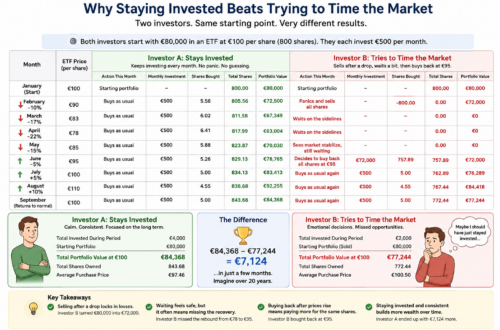
The reason is relatively simple. When you invest a fixed amount every month, you purchase more shares when prices are lower and fewer shares when prices are higher. Over time, this approach can result in a lower average purchase price than investing the same amount only at higher market levels.
This principle is known as dollar-cost averaging. It is one of the reasons why regular ETF savings plans can be useful for long-term investors who do not want to spend their time trying to identify the perfect moment to invest.
However, there is an important distinction between benefiting from lower prices and assuming that every falling stock is automatically a good investment.
A broad market decline may create attractive opportunities in companies that remain financially sound and continue to have good long-term prospects. But individual businesses can also lose their competitive position, accumulate excessive debt or face structural problems that prevent them from recovering.
The same applies to ETFs. A diversified global ETF offers exposure to many companies, but diversification does not eliminate market risk. If the global economy experiences a serious downturn, the value of the ETF can still fall considerably.
The decision to continue investing should therefore depend on your financial situation, the quality of your investments and the time you have available. If your emergency fund is in place, your income is stable and your investment horizon extends over many years, continuing your regular contributions may be a sensible approach.
If you are struggling to cover your monthly expenses or might need the invested money in the near future, protecting your financial stability should take priority.
The goal is not to invest as much as possible during every market decline. It is to maintain a strategy that you can realistically follow through both good and difficult times.
Should You Stop Your ETF Savings Plan During War and Inflation?
An ETF savings plan is particularly useful because it removes some of the emotional decisions associated with investing. Instead of trying to decide every month whether stock prices are attractive, you invest a predetermined amount at regular intervals.
But when geopolitical tensions increase, inflation pushes up household expenses and stock markets become volatile, it is understandable to question whether those automatic payments should continue.
There is no universal answer. The right decision depends on what is happening in the financial markets and, more importantly, what is happening in your own household.
Keep Investing: When Continuing Makes Sense
If your financial situation remains stable, continuing your ETF savings plan during a crisis can be a reasonable decision. You are investing for the long term, and temporary market declines are already part of the risk you accepted when you started investing.
Suppose you invest €300 every month in a broadly diversified global equity ETF. During a market downturn, the price of each ETF share decreases. Your monthly contribution now purchases more shares than it did before the decline.
If prices recover over the following years, those additional shares can contribute positively to your portfolio’s growth. Of course, a recovery is never guaranteed within a particular timeframe, and the market may fall further before it improves.
The advantage of regular investing is that you do not need to know exactly when the market has reached its lowest point. You simply continue following a plan that was designed for a long investment horizon.
For this approach to work, you need to be comfortable with the possibility of further losses and avoid investing money that you may need in the near future.
Buy More: When a Market Downturn Creates an Opportunity
If you have additional savings available beyond your emergency fund and your regular investment contributions, a market downturn may offer an opportunity to invest more.
Buying at lower prices can improve your potential long-term returns, particularly when you invest in a diversified portfolio of companies with sustainable business models.
However, buying more during a crisis requires careful consideration. Nobody knows whether the current decline represents the bottom of the market or merely the beginning of a longer downturn.
A market that has already fallen by fifteen percent can decline another fifteen percent. Even experienced investors cannot reliably identify the exact turning point.
For this reason, investing additional money gradually may be more comfortable than committing a large amount at once. You could spread an additional investment over several months, reducing the pressure to get the timing exactly right.
There is one important consideration: keeping money in cash while waiting for an even better buying opportunity also carries a cost. If markets recover before you invest, you may miss part of the recovery. Holding cash should therefore be a deliberate decision based on your financial needs and risk tolerance, not simply a reaction to uncertainty.
Pause Your Savings Plan: When Financial Security Comes First
Continuing an ETF savings plan should never become more important than maintaining a healthy household budget.
If inflation has increased your grocery bills, energy costs and housing expenses, your monthly financial flexibility may be considerably lower than it was when you started investing. The same applies if your income has become uncertain or you expect larger expenses in the near future.
In these circumstances, reducing your monthly contribution or temporarily pausing your savings plan can be the right decision.
You do not need to invest €300 every month simply because that was your original plan. If reducing the contribution to €150 gives you more breathing room, that may be a much better solution than continuing to invest an amount that leaves you financially stretched.
A temporary pause also does not mean that you have given up on investing. You can restart your savings plan when your financial situation improves.
The important thing is to distinguish between a pause caused by genuine financial needs and one caused purely by fear of falling stock prices.
Stop Investing: When Your Original Plan No Longer Fits Your Life
There are situations in which a more fundamental change to your investment strategy is necessary.
Perhaps you originally planned to invest for twenty years, but now expect to use the money within the next three years. Maybe your family circumstances have changed, you are approaching retirement or you have discovered that your portfolio exposes you to more risk than you can comfortably accept.
In these cases, simply continuing with the original ETF savings plan may no longer be appropriate.
You should review your investment horizon, the amount of risk you can afford to take and how much of your money needs to remain accessible. Depending on your circumstances, it may make sense to reduce your stock market exposure and hold a larger share of your savings in less volatile assets.
That decision should be based on a change in your personal financial goals, not on the assumption that you can avoid the next market decline by moving in and out of stocks at the right time.
How to Turn Market Crashes Into Long-Term Investment Opportunities
A falling stock market is uncomfortable for existing investors, but it can also create opportunities for people who are still building their portfolios.
When share prices decline, investors can purchase ownership in companies for less money than they would have paid before the downturn. If those companies remain profitable and continue growing over the long term, buying at lower valuations can improve future investment returns.
This is one of the reasons why market downturns are not necessarily bad news for long-term investors who are still accumulating wealth. If your ultimate goal is financial independence, understanding how your investments can eventually support your lifestyle is the next important step.
Consider someone who invests €500 every month in a diversified ETF. When the market is rising, that amount may purchase a certain number of shares. If the market falls by twenty percent, the same €500 can purchase considerably more shares.
Should the market eventually recover, those additional shares participate in the recovery as well. The investor has benefited from the lower purchase prices without having to predict exactly when the decline would end.
However, this example depends on the market recovering over the investor’s investment horizon. There is no guarantee that every market, company or sector will return to its previous level. Some businesses never recover from serious financial problems, and entire industries can lose their importance over time.
This is why diversification and a long investment horizon remain essential.
Why Market Timing Is So Difficult
The idea of selling before a market crash and buying again when prices are low sounds straightforward. If you could consistently do that, your investment returns would probably be considerably higher.
The difficulty lies in knowing when to act.
A stock market may continue rising despite political tensions, economic concerns or negative news. Selling too early can mean missing months or even years of gains. Waiting for a crash that never arrives can leave your money sitting in cash while investment prices continue increasing.
The opposite problem occurs when markets begin falling. You may decide to wait until the situation becomes more stable before investing again, only to discover that prices have already recovered substantially.
Some of the strongest market days have occurred close to periods of significant market stress. Missing a relatively small number of these recovery days can have a considerable impact on long-term investment results.
This does not mean that every investor should remain fully invested regardless of circumstances. It means that consistently predicting market movements is not a reliable foundation for building wealth.
A regular investment plan offers a different approach. Instead of trying to identify the perfect entry point, you spread your investments over time and allow your portfolio to develop through different market conditions.
Diversification Is More Important Than Finding the Perfect Crisis Investment
Whenever financial markets become unstable, certain investments receive considerable attention. Gold, energy companies, defence stocks and other sectors may appear attractive because they are associated with the economic consequences of a particular crisis.
However, investing in a sector simply because it is currently in the headlines can create new risks.
An industry that benefits from a particular geopolitical development may already have experienced a substantial increase in share prices. If expectations change or the situation develops differently than investors anticipated, those stocks can decline just as quickly.
A diversified portfolio is designed to avoid depending on a single economic development. By spreading investments across different companies, industries and geographical regions, you reduce the impact that problems in one particular area can have on your overall portfolio.
Diversification does not prevent losses during a broad market downturn, but it can make your portfolio less dependent on individual companies and sectors.
For most long-term investors, a well-diversified portfolio that matches their financial goals is a more reliable foundation than trying to identify which industries might benefit from the next crisis.
How to Protect Your Wealth Against Inflation and Economic Uncertainty
Building wealth is not simply about increasing the value of your investments. It is also about protecting your financial stability and preserving the purchasing power of your money.
Inflation is particularly important because it reduces what your savings can buy over time. If the prices of everyday goods and services increase faster than the interest you earn on your savings, the real value of your money decreases.
This can become a serious problem during periods of economic uncertainty, when household expenses rise while financial markets are struggling.
The first step towards protecting your wealth is maintaining an emergency fund. This money should remain accessible and should not depend on the performance of the stock market. Its purpose is to cover unexpected expenses, temporary income losses or other financial difficulties without forcing you to sell investments at an unfavourable moment.
The appropriate size of an emergency fund depends on your household expenses, income stability and personal circumstances. A household with one relatively unpredictable income source may need a larger reserve than someone with a very stable income and few financial obligations.
Once your financial safety net is in place, you can consider how different asset classes contribute to your long-term financial security.
Stocks and equity ETFs offer the potential for long-term growth, but their prices can fluctuate considerably. Bonds can provide a different source of income and may help balance a portfolio, although they also carry risks, including interest rate and credit risk. Cash provides liquidity and stability in nominal terms, but its purchasing power can decline during periods of inflation.
Gold is sometimes used as a store of value or as a way to diversify a portfolio, but its price can also fluctuate significantly. It does not generate interest or dividends, and there is no guarantee that it will rise whenever inflation or geopolitical tensions increase.
The important point is that no single asset offers complete protection against every economic situation.
A sensible financial strategy combines sufficient liquidity for short-term needs with investments that have the potential to grow over longer periods. The exact balance depends on your financial goals, your investment horizon and how much risk you can realistically tolerate.
The Biggest Investing Mistakes During a Financial Crisis
Financial crises tend to expose weaknesses in investment strategies that may have gone unnoticed during years of rising markets.
One of the biggest mistakes is investing money that should have remained available for everyday expenses or emergencies. If you need to sell stocks or ETFs to pay your bills, you may have no choice but to accept whatever price the market offers at that moment. An emergency fund helps prevent this situation and gives your investments the time they need to recover.
Another common mistake is constantly changing your portfolio in response to news reports. One week, investors are concerned about inflation. The following week, interest rates dominate the headlines, and shortly afterwards geopolitical developments become the main focus. If you adjust your investments every time the dominant concern changes, you risk turning a long-term strategy into a series of short-term guesses.
Chasing investments that appear to benefit from a crisis can also be dangerous. Rising prices in gold, energy or defence stocks may attract attention, but past performance does not guarantee that these investments will continue to rise. Buying simply because an asset has recently performed well can mean entering the market when expectations are already very high.
Finally, do not underestimate the psychological side of investing. A portfolio that looks perfectly reasonable on paper may become difficult to hold when its value falls by twenty or thirty percent. If you cannot sleep because of market fluctuations, your portfolio may carry more risk than you should take.
The best investment strategy is not necessarily the one with the highest theoretical return. It is the one that gives you a reasonable chance of reaching your financial goals while allowing you to remain invested through difficult periods.
Your Investment Strategy Should Survive the Next Crisis
There will always be another reason to worry about the financial markets. Political conflicts, economic recessions, inflation, changes in interest rates and unexpected global events are part of the environment in which investors operate.
You cannot control these developments, and you cannot reliably predict how the stock market will respond to every new crisis. What you can control is your own financial preparation, your investment decisions and the amount of risk you take.
A strong financial foundation starts with a manageable budget, an emergency fund and a clear understanding of your financial goals. From there, a diversified investment portfolio and a regular savings plan can help you build wealth over time without having to react to every market movement.
When stock prices fall, take the opportunity to review your situation rather than immediately changing your strategy. If your financial circumstances allow it, continuing to invest may be a sensible decision. If your household budget needs attention, reducing or temporarily pausing your contributions is equally reasonable. The important thing is to make that decision deliberately.
Market downturns can create opportunities, but they are not opportunities you need to chase at any cost. Investing more during a crisis only makes sense when your financial security is already in place and you understand the risks involved.
The real advantage of long-term investing is not that you can avoid every crisis. It is that you do not need to know what will happen next to make progress towards your financial goals.
A good investment strategy does not depend on a world without crises. It is built to withstand them.
Want to Build Wealth Beyond the Next Market Crisis?
Take control of your finances and build a stronger financial future. Step Up! guides you from budgeting and debt reduction to investing and financial independence.
Take the next step towards financial independence.
Get Step Up! on AmazonDisclaimer: This article is for informational purposes only and should not be taken as financial advice. Every investment involves risks, and it’s important to do your own research or consult with a licensed financial advisor before making decisions.