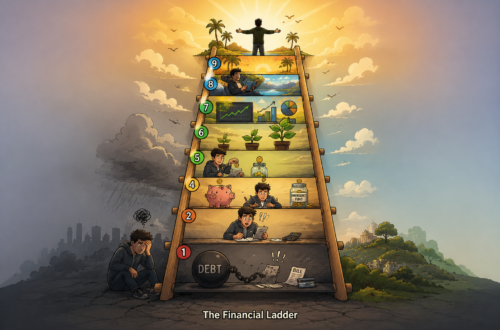
Before You Invest, Understand Why You Invest
Congratulations—you’ve reached a point that many people never do.
By the time you arrive at Step Four of the Financial Ladder, your financial life already looks very different from where it began. You understand your income and expenses, you’ve built healthy financial habits, and your emergency fund provides the security to deal with unexpected events without falling back into debt.
For the first time, you’re no longer asking how to survive until next month. Instead, you’re asking a much more exciting question:
What should I do with the money I don’t need today?
This is exactly where investing enters the picture.
Many beginners think investing starts with opening a brokerage account or choosing their first stock. In reality, those are some of the last steps. The real beginning is understanding why investing exists at all and what role it plays in building long-term wealth.
Once you understand that, every investment decision becomes much easier.
Saving Creates Stability—Investing Creates Growth
Saving money is one of the most important financial habits you can develop. Without savings, even relatively small unexpected expenses can become major financial problems.
An emergency fund gives you peace of mind. It allows you to repair your car, replace a broken washing machine or cover several months of living expenses without relying on loans or credit cards. That kind of security is invaluable.
But savings alone have one important limitation. Money sitting in a bank account usually doesn’t grow fast enough to increase your wealth over many years. One reason is inflation.
Every year, the prices of goods and services tend to increase. Sometimes the increase is barely noticeable, while in other years it becomes very obvious. Either way, inflation slowly reduces the purchasing power of your money.
Imagine you put €10,000 into a savings account and never touched it again. Ten or twenty years later, the balance might still show €10,000, but those same euros would buy considerably less than they did when you first deposited them.
In other words, your money hasn’t disappeared—but some of its purchasing power has. This is why long-term financial planning usually includes investing alongside saving. Savings protect your present.
Investments help build your future.
What Investing Really Means
The word “investing” often creates the wrong image. Some people immediately think about traders staring at multiple computer screens, constantly buying and selling stocks. Others imagine taking huge risks in the hope of getting rich overnight.
Neither picture reflects what long-term investing is actually about.
Investing simply means putting your money into productive assets instead of letting it sit idle. When you buy shares of a company, you become a small owner of that business. As companies grow, produce goods, develop new technologies and generate profits, their value often increases over time. Instead of relying solely on your own work to generate income, you now allow your money to participate in the growth of the economy.Your money starts working alongside you.That simple shift is one of the biggest differences between saving and investing.
Time Is More Valuable Than Money
Many beginners believe they need a large amount of money before investing makes sense. In reality, time is often far more important than the size of your first investment. Money invested over decades has the opportunity to benefit from compound growth. Any returns generated by your investments can themselves generate additional returns, creating a snowball effect that becomes stronger over time. At first, this growth often appears disappointingly slow but gradually, it begins to accelerate.
This is why experienced investors often encourage young people to start investing early, even if they can only invest small amounts each month. Someone who consistently invests €100 every month over many years will often accumulate more wealth than someone who waits ten years and then begins investing much larger amounts.
Consistency frequently matters more than perfection.
Risk Is Part of Investing
No investment offers guaranteed returns. Markets move up and down. Companies succeed and fail. Entire economies experience periods of rapid growth followed by recessions. This uncertainty is not a flaw in investing—it is part of the reason investors can earn higher long-term returns than people who simply keep their money in cash. Risk and return are closely connected.
Generally speaking, investments with higher expected returns also involve greater uncertainty.
Learning to accept temporary fluctuations without making emotional decisions is one of the most important skills an investor can develop. The goal is not to eliminate risk. The goal is to understand it and manage it wisely.
Diversification: Don’t Put Everything in One Basket
One of the oldest investment principles remains one of the best:
Don’t put all your eggs in one basket.
No one can predict which individual company, industry or country will perform best over the coming decades. Instead of trying to guess the future, successful investors usually spread their investments across many companies, industries and regions.This approach is called diversification.
Diversification cannot eliminate risk entirely, but it reduces the impact of individual failures and creates a more stable long-term investment portfolio. It’s one of the simplest ideas in investing, yet also one of the most powerful.
Knowledge Before Action
Many beginners feel pressure to invest as quickly as possible. While getting started is important, rushing into investments you don’t understand can become expensive. Before investing your first euro, spend some time learning.
Understand the difference between stocks, ETFs and bonds. Learn what compound growth actually means. Become familiar with concepts like diversification, volatility and long-term investing. The goal isn’t to become a financial expert overnight but to become confident enough to make informed decisions instead of emotional ones.
Knowledge reduces uncertainty, and confidence grows naturally from understanding.
Step Four Is About Preparation
At this stage of the Financial Ladder, you don’t need to know everything about investing.
You simply need to understand why investing becomes necessary once your financial foundation is secure.
Your emergency fund protects you against life’s surprises.
Investments help you build the future you want to create.
The two aren’t competitors—they work together:
Saving provides security.
Investing creates opportunity.
Once both are working together, you’ve built a financial system that is designed not only to protect your wealth, but also to grow it over time.
Looking Ahead
Understanding investing is the bridge between saving and building long-term wealth.
Once you understand the basic principles, you’re ready to put them into practice.
You’ve completed Step Four.
Your next milestone on the Financial Ladder is Step Five: Your First Investment, where you’ll take your first practical step into the world of investing.
Want to Go Deeper?
This article introduces the ideas behind Step Four of the Financial Ladder.
In my book Step Up! you’ll learn much more, including:
- common investing mistakes beginners can avoid
- why inflation quietly reduces purchasing power
- how compound growth creates long-term wealth
- the difference between stocks, ETFs and bonds
- why consistency usually beats trying to time the market
Disclaimer
This blog is for informational purposes only and should not be your sole guide for financial decisions. Always consult with a qualified financial professional before making major financial commitments.