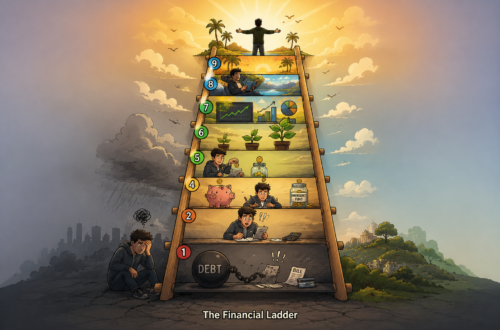
Reaching Step Five of the Financial Ladder is an exciting milestone. Your finances are stable, your debts are behind you, and you’ve built a financial safety net that protects you when life becomes unpredictable. For the first time, you can begin investing with confidence instead of worrying that every unexpected expense will force you to start over.
This is also the point where your relationship with money begins to change. Until now, every step has focused on improving your financial position through budgeting, saving, and reducing debt. Investing adds a completely new dimension, because your money can now start contributing to your future instead of simply sitting in a bank account.
Many people postpone their first investment because they feel they need to know everything before they begin. In reality, successful investing has far less to do with finding the perfect moment or the perfect product than with developing good habits and giving your investments enough time to grow.
Finding the Right Balance
Before investing, it’s worth asking yourself how comfortable you are with market fluctuations. Investments rarely move in a straight line. Some years are excellent, others can be disappointing, and occasionally markets fall sharply before recovering again.
The balance between savings and investments should therefore match your own personality. Some people sleep better knowing they always have a larger cash reserve, while others are comfortable investing almost everything that isn’t needed for emergencies. Neither approach is universally right or wrong. What matters is choosing a strategy that allows you to stay invested even when markets become volatile.
Time Is Your Greatest Advantage
One of the biggest advantages private investors have is time. Markets rise and fall constantly over short periods, but over decades they have historically rewarded patient investors.
Trying to predict the perfect moment to buy usually leads nowhere. Waiting for markets to fall often means missing years of growth, while investing regularly spreads your purchases over time and removes much of the pressure of making perfect decisions.
Successful investing is rarely about brilliant timing. It is far more often the result of consistency, patience, and allowing compound growth to do its work.
Keep It Simple
Your first investment doesn’t need to be exciting. In fact, simple investments are often the best ones.
Rather than trying to pick individual companies or follow the latest investment trends, many beginners choose broadly diversified ETFs that invest in hundreds or even thousands of companies around the world. Instead of relying on the success of a single business, you participate in the growth of the global economy as a whole.
Accumulating ETFs are particularly popular because dividends are automatically reinvested. That means every dividend immediately starts generating returns of its own without requiring any additional effort from you. Over many years, this compounding effect becomes one of the strongest drivers of long-term wealth.
Equally important are low costs. Small differences in annual fees may not seem significant today, but over twenty or thirty years they can amount to thousands of dollars that remain invested instead of being paid to fund managers.
Investing Is a Long-Term Habit
Many people assume that investing is about making spectacular returns. In reality, it is mostly about building a routine.
Investing a fixed amount every month, regardless of whether markets are rising or falling, removes emotion from the process and creates consistency. Some months you’ll buy at higher prices, some months at lower ones, but over many years this disciplined approach has proven remarkably effective.
Perhaps the most important lesson at this stage is that investing should support your life, not dominate it. Once you’ve built a sensible portfolio, there is little benefit in checking prices every day or reacting to every headline. Your greatest advantage is patience.
Looking Ahead
Your first investment is only the beginning. As your portfolio grows, your investments gradually become a larger contributor to your overall wealth, and over time they may even begin generating meaningful passive income.
Step Five marks the moment where your money truly starts working alongside you. The following stage is no longer about making the first investment but about steadily growing your portfolio over many years and letting time become one of your greatest financial assets.
If you’d like a deeper explanation of ETFs, diversification, compound growth and long-term investing strategies, you’ll find an entire chapter dedicated to these topics in my upcoming book Step Up!, where I explain not only what to do, but also why these principles have helped millions of investors build wealth over time.unts.
Disclaimer:
This blog is for informational purposes only and should not be your sole guide for financial decisions. Always consult with a qualified financial professional before making major financial commitments.