Choosing your first investment can feel a little like standing at the edge of a swimming pool, wondering how cold the water might be. You know it is time to jump in, but hesitation creeps in. What if you choose the wrong stock? What if you start too soon? The truth is, there is no perfect time and no perfect choice. The best investors are not those who waited for certainty – they are the ones who started.
Investing does not have to be complicated or intimidating. Once you understand a few core ideas, you can make smart, confident decisions right from the beginning. Let’s take it step by step.
Start with the Goal
Before you even think about what to buy, pause and ask yourself why you want to invest. Your goal shapes everything that follows.
Are you building a long-term nest egg for retirement? Saving for your children’s education? Hoping to create a small stream of extra income? Each goal has a slightly different timeline and level of risk that makes sense.
If you plan to use the money within a few years, keeping it safe (for example, in a savings account or low-risk fund) might be wiser. But if your goal is far in the future – 10, 20, or 30 years away – you can afford to take on more risk, because the market’s ups and downs tend to even out over time.
Investing is not about chasing the next big thing. It is about aligning your money with your life goals. Once that’s clear, every decision becomes easier.
Understand the Difference
When beginners hear about “stocks” and “ETFs,” the terms can sound technical, but the ideas are simple.
A stock represents ownership in a single company. When you buy one, you own a small piece of that business. If the company grows and profits, your share of it becomes more valuable. You might also receive dividends – small payments from the company’s earnings. But with higher potential returns comes higher risk. If that company struggles, your investment could fall in value quickly.
An ETF, short for Exchange Traded Fund, is a bundle of many different stocks (and sometimes bonds or commodities) packed into one product. Instead of owning one company, you own a little piece of hundreds or even thousands of them.
You can think of ETFs as a ready-made basket of investments. They track a certain index – for example, the MSCI World or S&P 500 – so they automatically follow the market. You do not need to pick winners and losers. You just invest in the whole basket and let time do its work.
For most beginners, ETFs are the easiest and safest way to start. They offer instant diversification and are far less stressful to manage than individual stocks.
Diversification Made Easy
Diversification is a fancy word for “not putting all your eggs in one basket.” It is one of the golden rules of investing.
When you spread your money across many companies, sectors, and countries, you protect yourself from big losses. If one company performs poorly, others can balance it out. ETFs make this process effortless.
For example, a single global ETF can include hundreds of companies from all over the world – from tech giants like Apple and Microsoft to smaller firms in Europe or Asia. With one product, you are already diversified across regions, industries, and currencies.
This built-in balance helps you stay calm when markets fluctuate. You are not betting everything on one company’s success – you are trusting in global economic growth over time.
Do Your Homework
Before you hit the “buy” button, take a few minutes to understand what you are investing in. It is not about becoming an expert analyst – just about knowing the basics.
If you choose an ETF, check which index it tracks. Is it global (like MSCI World), regional (like Euro Stoxx 50), or focused on a theme (like clean energy or technology)? Beginners often do best with broad, global ETFs, because they include companies from many parts of the world.
Next, look at the Total Expense Ratio (TER) – this is the annual fee you pay for the fund’s management. The lower, the better. Most good ETFs cost around 0.1% to 0.3% per year.
Finally, consider the fund’s size and provider. Well-known names like iShares, Vanguard, or Xtrackers are usually reliable.
If you prefer individual stocks, read about the company. What do they sell? How do they make money? Is it an industry you understand? Avoid buying a stock just because it is popular or hyped online. Your best guide is understanding and patience, not trends.

Don’t Overthink It
Many beginners get stuck in “analysis paralysis.” They read article after article, watch endless videos, and still feel unsure. The fear of making a mistake becomes stronger than the desire to start.
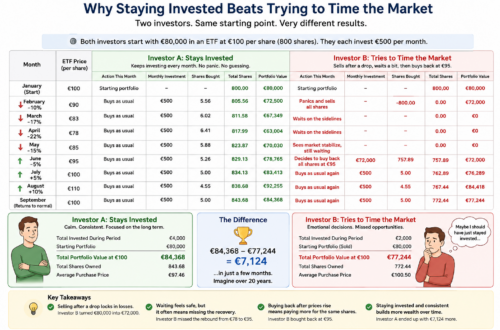
But here is the secret: even experienced investors make imperfect choices. What matters more is consistency. The market rewards those who stay in it, not those who wait for the perfect moment.
You do not need to predict the future. You just need to participate in it. Starting with a simple, broad ETF or one solid stock is enough. You can always adjust your plan as you learn more.
Think of it like planting a tree. The best time to plant it was years ago. The second-best time is today.
Keep It Simple
If you want a starting point that is easy and effective, consider a broad global ETF such as the MSCI World or FTSE All-World. These funds cover companies from dozens of countries and industries. You get exposure to thousands of businesses in one move – without ever needing to check daily stock charts.
Simplicity is a huge advantage. It reduces stress, saves time, and prevents emotional decisions. When you build your investment plan on something simple and consistent, you are more likely to stick with it – and that is where real success comes from.
Practical Step-by-Step for Your First Stock or ETF
Ready to take action? Here’s a simple process you can follow:
- Open an investment account with a reputable broker. Compare fees and ease of use. Many modern online brokers are beginner-friendly and allow you to invest even small amounts each month.
- Choose your investment – one broad ETF or a few stocks you understand.
- Set up an automatic savings plan. Start small – 25, 50, or 100 euros per month. The key is regularity, not the amount.
- Stick with your plan. Don’t check your portfolio daily. Review it once or twice a year to ensure it still fits your goals.
This routine turns investing from a scary decision into a simple habit. You will barely notice it in your monthly budget, but over time, those small contributions grow into something meaningful.
Your First Investment Isn’t About Perfection – It’s About Progress
Every investor starts somewhere. Nobody begins as an expert. Your first stock or ETF might not be the perfect choice, but it represents something much more important – the decision to take control of your financial future.
The sooner you start, the longer your money has to grow. Mistakes will happen, and that is fine. What matters most is that you learn, adapt, and stay consistent.
So take a deep breath, make your first move, and be proud of it. You are not just buying a piece of the market. You are investing in your own confidence, discipline, and future.
Disclaimer
The information in this article is for educational purposes only and does not constitute financial advice. Always do your own research or consult a qualified financial advisor before making investment decisions. Past performance does not guarantee future results, and all investments carry risk, including the potential loss of capital.