Step-by-Step Guide to Financial Independence
What is the Financial Ladder?
Financial success is rarely the result of a single decision. It is usually the outcome of hundreds of small choices made over many years. Saving a little more, avoiding unnecessary debt, building financial reserves and investing consistently may not feel spectacular in the moment, but together they create lasting financial security.
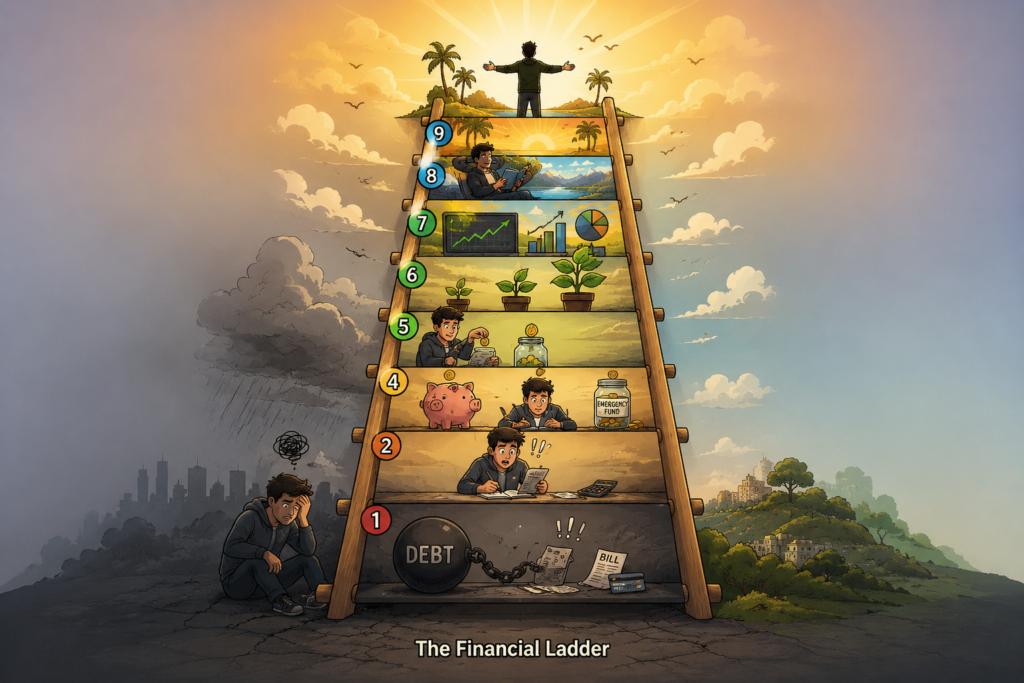
The Financial Ladder was created to bring structure to this journey. Instead of looking at personal finance as a collection of unrelated topics, it presents a clear sequence of priorities. Each step builds on the previous one and prepares the foundation for the next. Trying to skip a step often creates unnecessary risks, while following the right order makes financial progress more stable and easier to maintain.
The purpose of the ladder is not to compare yourself with others. It is simply a way to identify where you are today and what deserves your attention next.
Where Are You on the Financial Ladder?
Before setting financial goals, it is worth taking an honest look at your current situation. Every stage of the Financial Ladder has a different priority. Someone who is struggling with debt should focus on entirely different decisions than someone who already has substantial investments.
Knowing your current position allows you to spend your time and money where they have the greatest impact. Once one step has been completed, the next objective becomes clear.
The Financial Ladder consists of nine stages, beginning with understanding your finances and ending with complete financial independence.
Step Zero: Where Do I Stand?
Every financial journey starts with clarity. Before making plans or setting goals, you need to know where your money comes from, where it goes and what your financial situation actually looks like.
A detailed overview of your income, expenses, savings and liabilities creates the foundation for every decision that follows. Without this information, it is difficult to recognise problems or measure progress.
Step One: Financial Stability
Financial stability begins when your income reliably covers your living expenses. The immediate objective is to create a balanced monthly budget and avoid relying on debt to finance everyday life.
This stage is about establishing control over your finances and creating a stable foundation before moving on to larger financial goals.
Step Two: Paying Back Your Debt
Debt slows financial progress because part of every future income is already committed to past decisions. Eliminating high-interest debt therefore becomes the next priority.
As balances decrease, interest payments shrink and more of your income becomes available for building your future instead of paying for the past.
Step Three: Building Your Safety Net
Unexpected expenses are unavoidable. A broken car, temporary unemployment or medical costs can quickly become financial emergencies if no reserves are available.
Building an emergency fund creates stability during uncertain times and prevents unexpected events from turning into new debt.
Step Four: Understanding Investing
Before investing money, it is important to understand how investing actually works. Markets rise and fall, different asset classes carry different levels of risk and long-term success depends far more on knowledge and discipline than on finding the perfect investment.
This step focuses on building that understanding before committing significant amounts of money.
Step Five: Your First Investment
Once a solid financial foundation has been established and the principles of investing are understood, it is time to put that knowledge into practice.
The first investment is often the hardest because it transforms theory into action. Starting early allows time and compound growth to become valuable allies over the years.
Step Six: Growing Your Portfolio
Investing is not a single event but an ongoing process. As contributions continue and investments grow, the portfolio gradually becomes an increasingly important part of your financial life.
Consistency, patience and regular investing become more important than trying to predict short-term market movements.
Step Seven: Financial Independence
At this stage, your investments begin to generate meaningful income of their own. Financial independence no longer feels like a distant idea but becomes a realistic objective supported by years of disciplined financial decisions.
Work becomes increasingly optional as investment income takes over a larger share of your living expenses.
Step Eight: The Top of the Financial Ladder
The final step represents complete financial independence. Your investments are able to support your lifestyle without requiring active employment, giving you the freedom to decide how you spend your time.
Reaching the top of the Financial Ladder is not about becoming wealthy for its own sake. It is about having the financial security to make decisions based on your own priorities rather than financial necessity.
One Step at a Time
The Financial Ladder is not a race, and there is no advantage in comparing your progress with someone else’s. Every person starts from a different position and moves at a different pace.
What matters is taking the next appropriate step, building a solid foundation and allowing time to work in your favour. Progress may seem slow at first, but every completed stage makes the next one easier to reach.
The following articles explore each step of the Financial Ladder in greater detail and explain the principles behind them. If you would like a more comprehensive guide, including practical examples, calculations and exercises, you’ll find the complete framework in Step Up! Climbing the Financial Ladder to Financial Independence.
Disclaimer:
This blog is for informational purposes only and should not be your sole guide for financial decisions. Always consult with a qualified financial professional before making major financial commitments.